

Over the past decade, it’s felt as though the trickle-down of feminist thought into everyday language has done a sort of rehabilitation of the place of emotions in public life. The writing of bell hooks, for instance, surged across the 2010s, popularizing her theory of love as a tool for liberation, and in 2015, the influential American philosopher Martha Nussbaum wrote a book about the role of love in civic discourse. But where the public has been quick to embrace the transformative power of love, there has been more resistance to the idea of the political import of anger – even as it becomes a more and more justifiable response to current events. Is anger necessarily destructive and isolating? Or can it, like love, be used as a force for change?
Beware Her Fury Drawn & Quarterly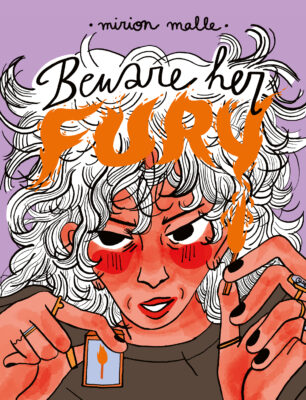
Mirion Malle
Translated by Aleshia Jensen and Isadora Jensen
$35
paperback
224pp
9781770468702
For Clémence, though, the anger isn’t a choice, and she resists the characterization. Indeed, she confides to a friend that she fears her rage is “consuming” her. Readers quickly learn that Clémence is beginning group therapy for survivors of sexual assault, and that while her anger often incites her to action – such as her impassioned defence of the two girls at the beginning of the story – it just as frequently leaves her paralyzed, evidenced in panel montages that show Clémence alternately going about her day and disassociating with fury in front of her phone, fidgeting, picking at her hair and skin as headlines stack up. This fine balance between rage that burns, and rage that burns out, is the balance Clémence must learn to strike.
It’s not easy, especially when reminders of patriarchal violence abound. But through conversations in group, support from friends, and vulnerability in a new relationship, Clémence begins to recover her relationship with anger as a productive rather than destructive force.
There is a sense in which Beware feels as though it’s all aftermath. We see the reverberations of assault on Clémence’s day-to-day, and there are references to a catatonic depression “last winter.” There’s the sense of a rock bottom, and that Clémence is no longer there. It’s as though the story opens just as the narrative swing ticks upwards, and we follow Clémence through a mostly frictionless recovery: her friends discuss serious topics while remaining lighthearted, group therapy is a hit off the bat, and Clémence finds herself in a new, healthy relationship that offers not only space, but strategies for navigating her complex emotions.
While some readers could complain of a lack of narrative tension – literally, it feels like nothing in this book goes wrong – I appreciated the ethical and creative choice to not depict Clémence’s assault in service of the narrative. Indeed, if there were an antithesis to the trauma plot, or to tropes where gratuitous sexual assault is recruited in the service of moving the narrative forwards, it would be this. Likewise, Clémence’s assailant receives little characterization, with Malle swapping an identifiable antagonist for a structural one. We only hear briefly that he is a “vaguely known” YouTuber, and the son of a certain “someone” in the public eye. These are juicy details to include, and doing so without elaborating feels like an intentional and refreshing baiting and subversion of the reader’s expectations.
Like Malle’s past work So Long, Sad Love (also translated by Aleshia Jensen), Beware Her Fury is a book that could be said to jump straight to the part of the story where things get better. Malle’s storytelling shines in its believable, candid dialogue, and there is something about her characters and settings, though at times minimally rendered, that feel recognizable and undeniably Montréalais. And while the story, too, is familiar, it offers something new: a reminder that anger is often a response to injustice, especially at the expense of those we love.
As to whether love or anger will lead the revolution, Beware Her Fury makes no strong distinction. Rather, it encourages us to think more deeply about the relationship between the two.mRb

0 Comments