


In her debut collection Wavering Futures, Toronto author Kawai Shen summons big doom energy. At every turn, Shen declines the siren calls of hand-wringing and hopeful sermonizing about the end of this world. Somewhere in between, she slips us a note on just how slim the chances are of survival, and the possibility of finding pleasure in that solemn fact.
Wavering Futures Metatron Press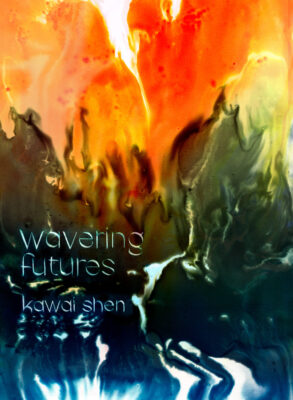
Kawai Shen
$20
paperback
120pp
9781988355740
The book’s middle section, “Imminent Collapse,” promises thematic weightiness, but skims on emotional force. Shen weaves grotesque details of climate catastrophe and far-right authoritarianism into an understated background. An expansive state euthanasia program, the failure of weather forecasting, and a scarcity of potable water are mentioned in passing.
In “Bottomless,” Gertrude, a night cleaner at a gay history archive, befriends the Head Archivist. She recalls a conversation with him before he was disappeared by the state. She’d asked him about predicting the future: “So then how do you know if you’re going to walk off a cliff?” His response: “Ah, that is a very good question… Because most people do not ask this until they are falling.” It’s not until each story is at its end that the irredeemable nature of the worlds Shen depicts sinks in.
While Shen’s worlds are effectively haunted, the dangers feel too familiar to spook. This is less a reflection on her craft than on the challenge of rendering present horrors on the page when fascists are making headlines every day. As with other experimental apocalyptic literature, Shen prioritizes fragmented, atmospheric conjuring over dramatic linear plots. The atmosphere? A sense of overwhelming impotence.
That’s not to say it’s sexless, though. In fact, I found Shen’s work most alluring in the erotica included in several stories. These climactic interventions ferry queer desire into the collective imagination. They proffer a strange satisfaction in denied gratification, in being overpowered. The third and final part of the book, “Survival Tactics,” gestures toward such microcosms of pleasure, albeit without much conviction.
In a second part of the story “Bottomless,” we learn that Gertrude becomes a dominatrix. Shen’s sharp lines bring her wicked characters into relief. After a scene of rough kink play, Gertrude sits by her slumbering sub: “‘You are enough,’ she murmured, lying to no one in particular. I could fucking crucify the kid, she thought, and nothing in this world would be redeemed.” At the end of this world, carnal delight may be the sole pursuit over which anyone has agency, Shen seems to suggest. Her characters revel in how inconsequential they are, modelling how one might find joy in being put (or trapped) in one’s place.
Story after story, the reader is given a bitter pill to swallow – one that doesn’t appear to contain healing properties. The book ends on a strange note with “19 Covid-Safe Scenes,” a series of erotic vignettes of intimacy under pandemic restrictions. The story recalls the improvisational approaches to pleasure that queer communities cultivated during the height of the HIV/AIDS crisis. Yet, the narrative almost insists on pushing away sentimentality about human connection. Settling on neither hope nor resignation, the collection feels suspended in a precarious nihilism that itself wavers on the edge of collapse.mRb



0 Comments