

I remember finding myself in a half-heated debate with a friend last year about reading, or more specifically its purpose. Though open to persuasion, our viewpoints essentially boiled down to this. His: the act of reading should, first and foremost, be a brain-swelling pursuit of knowledge; and mine: to read is to primarily seek the warm embrace of escapism. I, after all, am an individual who survived lockdown by working my way through Jilly Cooper’s “bonkbuster” catalogue. How special, then, to just for a moment step away from our crumbling world and into one of noir.
The Longest Death Houes of Anansi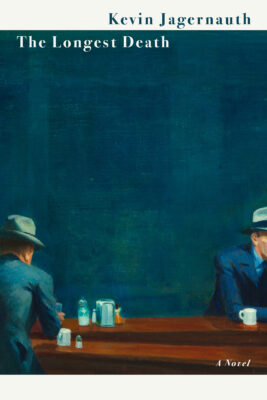
Kevin Jagernauth
$26.99
paperback
320pp
9781487013950
It is a vivid world that Jagernauth paints, a misty landscape replete with an identity parade that would not be out of place in a game of Clue – including, but not limited to, a rogue cop turned PI, an enigmatic pawnshop owner, a nosy diner waitress, an eager car salesman, and a paranoid tycoon. Gloria, the novel’s femme fatale figure (rendered with the kind of bus-stopping, jaw-dropping beauty only male writers seem capable of dreaming up) catches wind of the plot, and plans between the three ensue. With their common goal of escaping Riverton and lives that don’t fit quite right, the trio share a kind of exceptionality that seemingly stems from social “otherness.” The queer love story is a modern twist, and furnishes the novel’s chilly atmosphere with tender sparks of warmth. Indeed, Richard and Marlon’s relationship feels refreshingly… normal. Supporting characters are remarkably unfazed and the only blatant moment of homophobia that occurs (in a gun store, of course) is promptly, and satisfactorily, avenged.
The novel’s defining trait is its Technicolor catalogue of hard-boiled slang, an ambitious feat in and of itself. The noir lexicon is marvellously theatrical; it leaps and dances across the pages, requiring the same level of concentration one might reserve for a Sunday crossword. Though there is pleasure to be found in decoding dialect relegated to a different stretch of history, at times its employment is heavy-handed, resulting in moments of spoof that make it difficult to fully immerse into the story. Lexicon aside, Jagernauth’s writing is an acquired taste; it is thoughtful, tense. Through lingering looks, and feelings of dread and paranoia, Jagernauth gently tugs us into his hard-bitten, slow-moving noir playbook.
However, the novel’s third act is its strongest. The heist materialises, deteriorates and in a frustratingly bathetic turn of events, a version of the sought-after “dream” finally manifests. It is an unsatisfactory conclusion and deliberately so. Jagernauth leans into the cynicism of his chosen genre, revealing the aspirational, illusory nature of the American Dream.
Indeed, while there is a case to be made that novels like The Longest Death belong to another epoch (certainly the aesthetic qualities alone make it an acquired taste), perhaps what is so interesting about this novel, so firmly planted in its “retro-ness,” is its contemporaneity with the moment of late-stage capitalism in which we now find ourselves (in which case, Jagernauth’s fiction is not entirely the sweet release of escapism I initially had it pigeonholed as). Given noir originated in the turbulent conditions and disillusionment of the post-war years, there is a certain allegorical characteristic to the novel’s anticlimactic deflation of narrative – be this Jagernauth’s intention or not. The longest death, it seems, may in fact just be life. Like those who came before him, Jagernauth uses noir as a tool through which to suggest that there is little point deigning to believe in upward mobility in a system designed to relentlessly attrit the human spirit. After all, it’s the hope that’ll kill ya.mRb

0 Comments