

It’s not uncommon for a book’s dedication to carry a certain emotional poignancy. In the case of Arizona O’Neill’s stunning debut graphic memoir, though, it’s more like a full-on emotional wallop. “To the parts of my father still out in the world,” the dedication reads, and therein lie tales within tales.
Opioids & Organs Drawn & Quarterly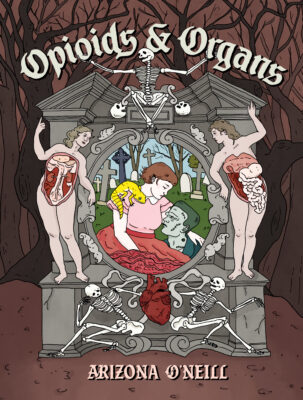
Arizona O'Neill
$35
hardcover
380pp
9781770468450
Opioids & Organs is essentially O’Neill’s account of fighting through that guilt and getting to its root causes. Early on, a hard truth was apparent: you don’t see organs – hearts and eyes and all the others – migrating from the rich to the poor. No, somehow when it comes to the movement of organs along the lines of the human class divide, all the traffic is in the opposite direction.
The book effectively becomes a road novel, both literal and metaphysical. Along the way O’Neill discovers that her position entails a double bind: not only do you inevitably feel guilty, you can end up feeling guilty about feeling guilty. Harvested organs, after all, are literally saving lives, and their procurement is always a time-sensitive matter, to put it mildly. Is there really any good reason to hinder the process? The question hangs in the air, and it’s a big part of the book’s power that O’Neill allows the ambiguity to stand.
A big part of what makes Opioids & Organs unique is the freedom O’Neill allows herself – freedom to go down narrative paths that might at first look like dead ends (hint: they’re not dead ends, though some prove more fruitful than others) and, maybe most daringly, to bring a comic element – that’s comic as in comical, not as in comix – to what many might reasonably assume to be a subject utterly resistant to the very idea of levity. Never mind gallows humour. This is post-gallows humour.
Tonally, the range of what O’Neill is doing calls for the kinds of shifts and hard turns that can make a creative writing teacher weep. One minute, you might be deep in reflection regarding the very nature of life and death; the next, you’ll be chortling at the wisecracks of a talking lizard. But O’Neill is a sure hand at the wheel. The real, the unreal and the surreal end up coexisting amiably; they meld into each other with a seamlessness that comes to feel almost natural.
In the tradition of her mother, acclaimed novelist Heather O’Neill, the author shows a deep-rooted love and affinity for Montreal: its architecture, its history, its outcasts and iconoclasts.It should hardly need saying that the book is a visual feast. O’Neill is a masterful drafter of line; the results often verge on breathtaking, especially when panel sizes accommodate a profusion of detail.
The book itself, with its embossed hard cover, heavy-stock paper, and deep, rich colour palette, is an objet d’art in its own right. Panel shapes come in all permutations and combinations, their fluidity arising organically from narrative and thematic needs.
Structurally speaking, it might have been easy for O’Neill to resort to blocks of context-setting expository writing. Instead, she chooses to have all the text embedded solely as attributed dialogue. Not only does this keep the story moving along crisply, it enhances the sense of a Greek chorus of empathy, of a father’s legacy making its way out into the world via the tribute of the daughter he barely knew, one voice at a time. Or – as will surely be the case now, and in increasing numbers – one reader at a time. mRb
0 Comments