

“Who does one write for? For whom does one draw? By whom is one drawn in, drawn forth, drawn into?”
Natalie Doonan’s debut book, Eating the Urban Wild, is a vivid, multi-genre account of one woman’s personal experience connecting with place, specifically the borough of Verdun in Montreal, through an exploration of its food. Facts and historical details dance with sketches and poems between scenes of the author’s experience in creating the work. It is also a rigorously researched academic text intertwining cultural and animal geographies with sensory and performance ethnographies. Doonan asks us to consider what it means to think of food as relational, and to see the unbreakable connection between place and food.
Eating the Urban Wild McGill-Queen's University Press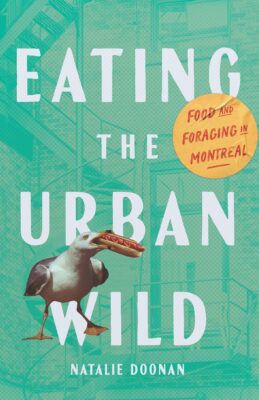
Food and Foraging in Montreal
Natalie Doonan
$29.95
paperback
336pp
9780228027966
When we meet to discuss her book, we trudge to a few fancier cafés, all too loud and busy for our purpose, before finding space at a doughnut shop. No judgement. Part of foraging is working within the parameters of what’s available in one’s environment, she tells me. We’re close to the Concordia campus, where she is working on a research-themed residency, or research on research. This meta-style conceptualization provides the building material for her thought bridges. After an earlier education in visual and performance arts, Doonan chose to undertake an interdisciplinary PhD at Concordia, combining her main focus, Sensory Studies, with Cultural Geography and Performance Studies. The expansive literature and outlook came into play with her artistic practice, and a new project, aptly named The Sensorium, was born. Doonan created a series of artist-led tours as a way to bring together the senses, engendering connection to place through tasting and walking. “The first thing we do when we come to a new place? We taste the place, we taste its unique dishes, and we go on tours to get to know different neighbourhoods and areas,” she says.
Doonan’s geographical focus for Eating the Urban Wild was motivated by two main factors. Her father and grandfather spent most of their lives in Verdun. After her PhD study took her to the isolated lower north shore of Quebec, it was important for Doonan’s next project to be anchored in a place closer to home to facilitate community relationship building while she worked. Secondly, since Lenore Newman had conducted a survey of Canadian foods across Canada to write Speaking In Cod Tongues (2017), Doonan was inspired to complement the broad research with a bounded, vertical sampling of one neighbourhood. Verdun was close and held personal connections – a perfect fit, and ripe for study with layer upon layer of food strata to be explored within one community.
As part of her research, Doonan asked Ehsan, a friend in Verdun, to take her food shopping, and she was charmed to find his process thoughtful. She writes, “The aesthetic dimension of the sensory practices developed by Ehsan through his grocery shopping regime should not be overlooked. A caring aesthetics is relational and counters the myth that food is conjured from the grocery store.” Throughout the book, tours of food experiences and concepts of food relationships are presented for our consideration, from foraging wild plants to hunting wild game, or visiting the local butcher for some chit chat and a steak, then zipping in the big box store for quick convenience. The butcher shop was special to Ehsan. He took pleasure in his relationship with the people there and its decor, where every surface is “adorned with an assemblage of cultural ephemera,” including hockey memorabilia, childhood toys, and a bit of taxidermy. The sensory experience and social component played a role in his enjoyment of the process. Paying attention to the aesthetics approach in the way we decide to gather supplies for dinner can elevate not only our eating experience, but also our daily lives.
It’s important to note the book is not meant to be prescriptive, but rather a source for contemplation. Doonan takes pains to remain as impartial as possible. The most heartrending scenes in Eating the Urban Wild are born of this desire to stay open when faced with the violence of death essential to feeding life, particularly with the hunters and fishers in the act of harvesting their prey on and around the St. Lawrence River. “I try to hold in tension the complexities and contradictions inherent to interspecies communication through encounters with the urban wild, and to ask whether these can teach us better ways of coexisting,” she states in her opening lines. Doonan often looks to the traditional teachings of the First Nations, who inhabit these lands in harmony with plants and animals to help her find equanimity, and provide a counterpoint to the capitalistic structures currently dominating the dictates of what and how we eat.
“Our senses are not separate,” she explains to me. “When we see something that looks delicious, our mouth waters.” In her work, she asks us to consider the ways we connect to everything around us. There is physical contact taking place when we look at something. To varying degrees, we all experience synesthesia. For example, the intimate contact between hunter and prey is not only physical touch, but also visual touch. “While the bird entered into the body of the man, the man similarly penetrated the body of the bird, visually, though there was clearly an exchange of other biological material too. Thus, the last image that was imprinted on the optical apparatus of that mallard was that of their killer. Since I was nearby, the bird and I also shared this exchange. To put this in the language of Despret writing about ‘embodied empathy,’ in that moment I witnessed a mallard’s body being literally ‘undone and redone’ by the human.” Here Doonan is referencing Vinciane Despret, a Belgian philosopher of science whose work decentres humans in historical study in favour of animals. Doonan’s book is full of references to other academic work, encouraging readers to spread their intellectual wings with investigations of their own to fully understand the ideas presented.
“There are no easy answers for how to think about the plants and animals we eat. If I eat this way, or adopt such-and-such diet, will it solve all the problems? Like anything, there are pros and cons to every decision we make.” I notice the compassion in her voice. Doonan’s work is not meant as a set of rules, but rather a jumping-off place for consideration. She strives to encourage us to think about our food choices and make deliberate decisions, whatever they may be, creating a mindfulness around how we choose. “You should get a doughnut before we leave. I’ve heard they’re fantastic,” she tells me.
“The alienation, the feeling of separation created by the structure of capitalism centered on the individual – it’s a myth,” she tells me. All life forms share an organismic connection. To even think about food as the severed parts of animals and plants on a plate without thinking about the wider relations is irrational. “Emplacement adds a dimension of environment to embodiment.” Her words sew a compartmentalized view of food in a sterile package to the greater wild world of edible possibilities around us, and ask us to consciously consider the connections.mRb

0 Comments