

Both Rawi Hage and Madeleine Thien are not exactly recognized for producing “small books,” literally or figuratively. So, imagine my surprise when The Call and The Artisans—hand-sized, slim works penned respectively by Hage and Thien—landed on my desk. They strike me as the literary equivalent of the “Tiny Desk Concerts,” featuring international musicians who perform live, stripped-down but remarkable gigs in close quarters at NPR Music’s head office in Washington D.C. Compact and pithy, these books are part of a series called “Objects Talk Back,” an initiative dating back to 2021 and published by Diaphanes, which annually invites two writers to select an object displayed in the Humboldt Forum, Berlin, or in the museum’s collections and then to riff off the object in personal and imaginative ways.
The Call Diaphanes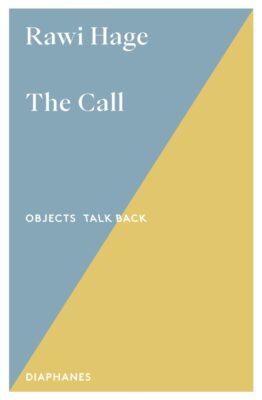
Rawi Hage
$10
paperback
48pp
9783035807950
As it happens, digging deep is one of both Thien and Hage’s many gifts. Thien’s The Artisan is a finely crafted short story in response to a mural fragment depicting three Uyghur princes, who contributed to the construction of a sanctuary in the Bezeklik Thousand Buddha Caves along the Northern Silk Road (outside the city of Turfan, in the present-day Xinjiang Uighur Autonomous Region, China). The mural fragment, formally referred to as Bezeklik Cave 20, was removed by Albert von Le Coq and brought to the Berlin museum following the Second German Turfan Expedition (1904–5); it was all but destroyed by the Allied bombings. Neither the colonial imperative, nor its relationship to the current political moment are lost on Thien. Her story, set around the eleventh century, during the years of the Uyghur Kingdom of Kocho, is in part about power dynamics but also about spiritual enlightenment. It is told from the perspective of an artist, a judicious choice: the artist’s view, measured against that of the prince, reminds us of the former’s enduring vision, and of the importance of art and artists.
The Artisans Diaphanes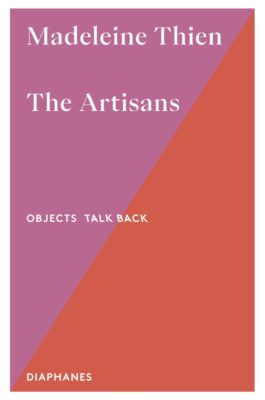
Madeleine Thien
$10
paperback
48pp
9783035807943
It is impossible, he adds, to display everything in view of how much Europe has amassed—often through exploitation—and so he calls for an “autonomous Republic of Objects,” whereby museums throughout the world would be transformed into places of refuge under the care of an international body of librarians and grant egalitarian public access. Whether this is possible isn’t his point—it is the dream of striving and the promise of return, the very thing that artists, like those represented in Thien’s story, offer us.mRb

0 Comments