


The role of religion in public life has long been a contentious topic in Quebec. The Quiet Revolution of the 1960s significantly reduced the Catholic Church’s role in education, healthcare, and social services, resulting in a decline in religious practice among the population. While this period is rightfully credited with modernizing Quebec’s institutions, it is clear today that the CAQ government invokes secularism to target and stigmatize immigrant communities while undermining many of the same public institutions. One only has to look at how the CAQ’s recent inflammatory rhetoric and legislation banning public prayer coincide with widespread cuts to the education sector.
A Different Cloth Ronsdale Press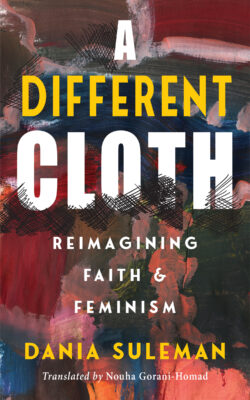
Reimagining Faith and Feminism
Dania Suleman
Translated by Nouha Gorani-Homad
$19.95
paperback
130pp
9781553807346
Suleman starts by challenging the notion that freedom of religion represents a threat to the rights and responsibilities of citizens in a democratic society. She sifts through multiple Supreme Court of Canada decisions to show how our legal system has always placed contingencies on the right to religious freedom. For instance, the courts weigh freedom of religion against other interests, such as public safety and social equality. Infringement of religious freedom must also be objectively demonstrated. People can not just ask for exemptions on religious grounds; instead, they have to prove that their right to freely practice their religion is being impeded.
Moreover, Suleman discusses how, despite a couple of sensationalized cases, a majority of legal requests for religious accommodation do not clash with gender equality. More often, people are simply seeking accommodations in the workplace for rituals or holidays. Conservative politicians and commentators fear-monger about religious freedoms gone amok, often speaking in coded terms about minorities and immigrants. Suleman presents a more sobering and grounded view of the situation. She shows that our legal system does not treat religious freedom as an absolute, and is quite rigorous in the way that it applies the principle of gender equality to cases related to religious freedom.
Yet despite all of this evidence and data, the fear-mongering still works, and it has led to public discourse and legislation that marginalize the most vulnerable people in our society. Suleman discusses the disproportionate impact of Bill 21, which bans religious symbols for public sector employees, on Muslim women. She cites stories from these women, particularly those studying or working in education, who now fear the loss of income, barriers to professional advancement, and harassment. There is a cruel irony in the way that proponents of this bill invoke Islam’s oppression of women while championing the exclusion of Muslim women from the workplace and public life more broadly. While Quebec prides itself on the rapid modernization of its society, Suleman astutely notes how legislation like Bill 21 is “grounded in subjective feeling,” notably manufactured prejudice and fear, rather than meaningful social, cultural, or economic considerations.
The book ends with a reflection on feminist theology – the ways that women find meaning, community, and empowerment in their faith. Suleman offers examples of women who return to the feminist roots of their religion, those who reinterpret religion through a feminist lens, and those who reject and resist patriarchal practices within their religious communities. Suleman hopes that her research and writing will contribute to the creation of “societies that are not content to simply manage tensions, but also seek to reimagine the possibilities.” But beyond just offering a more nuanced view of religion needed for a harmonious multicultural society, Suleman’s work exposes and counters the sensationalist narratives about religion in our society that are often a vehicle for othering and an obstacle to solidarity. mRb


0 Comments