


While picking a place to eat out, an Indian restaurant is always a mental battle for me. Do I wish to pay to eat something I could easily make at home? Or should I just pay for the convenience? What really bothers me is the heavy lifting done by the adjective “Indian”; imagine trying to describe a landmass that contains multiple culinary traditions in a single adjective. This often means that Indian food in this part of the world is reduced to a standard menu, with butter chicken as the highlight. Annapurna’s Bounty by Veena Gokhale is a refreshing take on Indian food; it captures several culinary influences, encompassing the gastronomic and geographical diversity of the country. The book is structured as a collection of short stories; each story is accompanied by a vegetarian recipe.
Annapurna’s Bounty Dundurn Press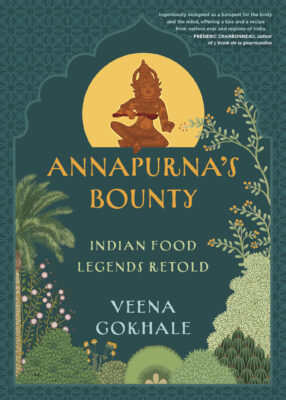
Indian Food Legends Retold
Veena Gokhale
$24.99
232pp
9781459754591
All the stories in the collection are about vegetarian food. In the first story, for instance, when Zoroastrians arrive in India, they note that many inhabitants of the new land are vegetarian. While India might offer more options for vegetarians, to say that it is a vegetarian country is a misconception. It is easy to characterize vegetarianism and non-vegetarianism as personal choices; however, in a country such as India, food remains inherently political. This becomes somewhat evident in the second story in the collection, which connects food and caste. In “Parvati Bai and the Bandits,” the lady of a Brahmin household feeds a vegetarian feast to lower-caste bandits. Brahmins are at the top of the caste hierarchy and consume vegetarian food. The descriptions of the feast are luxurious, the author taking time to list various dishes. However, the head cook whispers about how the feast is wasted on the dakus or bandits. The question of caste and ritual pollution also appears in another story about Guru Nanak, the founder of Sikhism. In “Do the Right Thing,” Guru Nanak asks a Brahmin the logic behind offering gods the “purest food” (usually vegetarian) which is made by discriminating against other humans belonging to lower castes.
In addition to inviting reflections on how food can be political, the author also problematizes the word “curry” itself, which has become a catch-all with respect to Indian food. In a section titled the “Interlude,” Gokhale dives into the history of the word curry itself, including what constitutes a curry. Stating that the word was an invention of the British to describe a dish with a sauce, the author turns her attention to the British colonial epoch with the story “Chef William and Captain Tyrant.” The story features an Anglo-Indian recipe, illustrating how the British chef in the story adapted his cooking techniques to use Indian ingredients.
The stories in the collection feature the different confluences that have shaped “Indian” food and encompass geographical and historical variety. For instance, “The Emperor who Loved Mangoes” is about Akbar and Birbal, the former being the famous Mughal emperor and the latter his trusted right hand. “Three Grains of Mustard” is about lord Buddha.
Geographically, the stories are not just confined to the north. Set in South India, “The Cries of Animals” looks at nonhumans and their plight. I was delighted to see an adapted recipe for aviyal (a vegetable dish with shredded coconut), something I had grown up eating, which is usually not a staple on the standard North American restaurant menu. Some recipes in the book have been revised so that the ingredients are easier to find in North America. For those interested in discovering more about Indian cuisine and its diverse influences, this collection could serve as a starting point. If you enjoy a mix of fact and fiction or fictive retellings of history, this collection will speak to you. As for me, I was happy to read this collection of short stories on “Indian” food in which the adjective is indeed doing some heavy lifting, through its emphasis on geographical diversity.mRb



0 Comments