

We live in calamitous times: wildfires run rampant, wars proliferate, rising seas threaten to swallow shores and devastate coastal populations. And if the tenor of contemporary politics is anything to go by, the world’s leaders won’t be prepared to solve these problems any time soon. Things are likely to get worse, much worse, before they get better. How can we cope?
Before We Forget Dundurn Press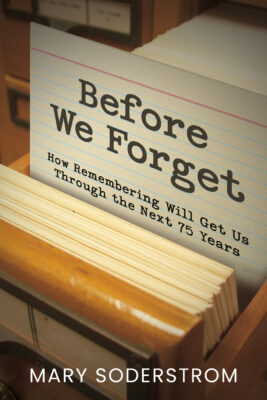
How Remembering Will Get Us Through the Next 75 Years
Mary Soderstrom
$26.99
paperback
248pp
9781459755857
It’s a compelling argument, made all the more so by Soderstrom’s skillful storytelling and engaging, accessible style. The first section of the book presents an overview of memory as Soderstrom conceives of it. We learn how the brain develops and stores memories. We learn about the history of libraries and how they, along with archives and the internet, have evolved to be the great storehouses of humans’ “collective memories.” We also learn how our memories can fail us and explore how some – such as autocrats who actively spread disinformation – try to manipulate others’ memories for their own gain. Throughout, Soderstrom interweaves fascinating tidbits from science and history, as well as reflections on her own life, which offer a thematic throughline and a welcome emotional depth.
The book’s middle section turns to three case studies – China, Rome, and the Indigenous peoples of Turtle Island – to show how past cultures have faced societal collapse, yet maintained (or resurrected) their heritage. The breadth of the research here is impressive, and these chapters make for some of the book’s most scintillating moments, even if Soderstrom gets the occasional fact wrong. (Julius Caesar was hardly the first dictator of the Roman Republic, and res publica, from which the word “republic” comes, can be better translated as “the public thing” than “property of the people.”) At times, Soderstrom shows a penchant for citing some rather heterodox thinkers to support her assertions. The most notable example is Peter Turchin, who’s something of a modern-day Nostradamus: Through the study of what he calls “cliodynamics,” he claims to be able to predict the future by analyzing statistical information from historical societies, however unreliable those statistics may be the further back in time one goes.
In the book’s final section, Soderstrom examines what she considers to be the three great challenges of the twenty-first century: “climate change, war and civil conflict, and artificial intelligence.” Whether the three are of equal menace is still to be seen, but Soderstrom convincingly argues that they are not only global but also deeply intertwined threats, feeding and reinforcing each other.
The last chapter provides a brief overview of what Soderstrom considers vital to remember. The list is surprisingly modest and includes such skills as digging a latrine, mending clothes, writing, and playing a musical instrument. If this seems bleak, that’s because it is. Her vision of the future is one where little is certain, where familiar comforts like electricity or indoor plumbing have vanished or, at best, are no longer guaranteed. It’s a future where, frankly, we’ve lost.
But perhaps there’s still a future worth fighting for. Perhaps we can ask for more than mere survival – and for that, we’ll need more than memories. After all, as Soderstrom acknowledges, our memories can lead us astray, especially as the internet swells with disinformation fuelled by artificial intelligence. Knowledge is only half the battle. Wisdom, critical thinking, the political will and courage to act: if we’re to turn things around, we’ll need those, too, along with the vision and verve to dream up solutions to our present-day problems. mRb

0 Comments