


What does a cup of tea have to do with contemporary migration patterns? Or a library in Dresden with the destruction of Mayan manuscripts in 1562? Quite a lot, suggests Episodes from a Colonial Present. The academic anthology-cum-graphic novel reveals the seemingly unlikely legacies of colonialism in our everyday lives. While much of the book surfaces these fascinating interrelations through the digestible medium of the graphic novel, its storytelling occasionally flounders under the weight of its theoretical commitments.
Half a dozen “episodes” draw on the personal experiences of the book’s diverse cast of authors and illustrators, exploring the contradictions – and potential solidarities – that arise within our colonial present. Each episode is interspersed with an “intermezzo,” mixing short stories and dense theoretical investigations. While the common theme of colonialism runs throughout, the fact that each story is created by different writers and illustrators makes for a great deal of aesthetic and thematic variation.
Episodes from a Colonial Present Daraja Press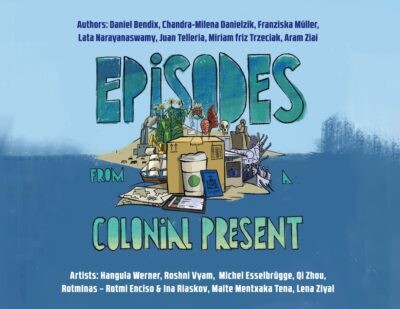
Various authors
$34.55
paper
104pp
9781990263460
Some episodes are more adept than others in forging theory, autofiction and imagery into a coherent whole. The book’s distinctive – if somewhat limiting – focus on Germany resurfaces in Daniel Bendix and Hangula Werner’s “Tracking Trauma: German Genocides at Home and Abroad,” which offers a much-needed intervention in Germany’s memoryscape by drawing parallels between the Holocaust and the colonial genocide of the Ovaherero, Nama, San, and Damara peoples in what is now Namibia. Although clearly well-researched, the story struggles to find its narrative footing, with the plot and dialogue feeling somewhat like an afterthought.
These authors have clearly reflected on their own positionalities in relation to colonialism and its enduring legacies. One might therefore have expected a story exploring the book’s own migration, both conceptual and physical, from writers to publishers all the way to its readers. In the introduction, the authors emphasize the significant colonial power structures at play in the distribution of cultural resources – for instance, who receives funding and who earns royalties. Paid for by the European Union and several German cultural institutions, created by a largely European-based group of writers, and published by Quebec-based Daraja Press, the book’s own journey serves as a fascinating case study in how knowledge, and other forms of capital and power, continue to travel global routes shaped by colonial histories.
Episodes from a Colonial Present largely succeeds in its goal of bringing postcolonial critique into the everyday. An engaging read, the graphic novel is strongest when its illustrations are seamlessly integrated with its theoretical and autofictional foundations, rather than simply layered over them. While Episodes from a Colonial Present’s focus on Germany’s implication in colonial crimes offers a novel perspective for readers from elsewhere, the book sometimes struggles to balance this with its broader global claims – at points assuming a decidedly European audience. mRb

0 Comments