

Su J. Sokol (xe/xir) invites us into a world both optimistic and troubling in xir new hopepunk speculative fiction novel, Five Points on an Invisible Line. The recently released sequel to Invisible Line continues to opt for multiple first-person narrators following a family of five. Over three sections, we accompany them on their collective and personal journeys in a near-future Montreal, a time with integrated advanced technology; most information and communication is accessed through holograms and wrist pads, and citizens have the option to embed identity chips into their wrists. Together, they navigate existing and changing family dynamics, sexuality, mental health, and activism under an oppressive regime.
Five Points on an Invisible Line Flame Arrow Publishing 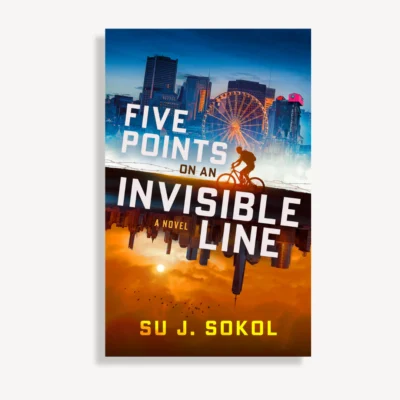
Su J. Sokol
$22.99
Paper
428pp
9781990368240
As Janie searches for a way to secure Philip’s residency in Quebec, she participates in local actions through a music group, the “Insurrection Band.” A sudden death and the mysterious disappearances of some of Laek’s students heighten his paranoia as he struggles to manage PTSD symptoms from painful past experiences. Philip tries to uncover Laek’s past to connect with him and make sense of their relationship while wanting to continue being a supportive father-figure to the kids, including his own daughter across the border. While Siri tries to find her place in the activist group Jeune Vanguard, she is confronted with someone from her past who makes this more difficult than expected. Determined to become someone the group can rely on, she learns to channel her anger into action. Innocently and authentically, Simon navigates friendship and unfamiliar tensions that feel distracting from his interests.
Sokol contrasts the functional and romanticised way the family exists in their community within their off-grid co-op with rooftop gardens, everyone passionate about a cause – not far from the way of life many queers live and dream of – with having to resist an authoritarian government viciously intent on upholding strict immigration and border policies, in partnership with the United America. Sokol doesn’t hide xir criticism of Quebec’s rampant racism and xenophobia in the story’s projection of how these dangerous ideologies could continue to impact our future if left unchecked.
Struggling between being both character and plot-driven, it is often difficult to locate the direction of the story. Between a strong focus on the development of the adult characters’ polyamorous relationship and the very detailed thought processes of each of the narrators, readers’ imaginations might be left with both too much and not enough.
The book rushes to a climax and due to this hastiness, the reader is not set up to invest in the story’s end as one would expect the book’s many pages to do. Perhaps the use of fewer narrators would have given the story more opportunity to develop, instead of sacrificing it to include more perspectives. However, one thing that remains consistent throughout the novel are the strong bonds between the characters– their deep love and respect for one another held above all.
The epilogue, light-hearted and sentimental, brings forward the novel’s main motif of optimism. Each character seems to have gone through a process of maturation, making peace with the struggles they were grappling with throughout the book. An idyllic projection of poly-queer futures, Five Points on an Invisible Line underlines what lived realities may look like for those who function in opposition to the status quo. mRb

0 Comments