


“My grandmother once told me that you had to walk more responsibly after you had witnessed something. It was her way of saying that the past and the present collide.” This is just one of the multiple memories that encapsulate the wonderful and gripping life odyssey chronicled by Fred Anderson in his new memoir Eyes Have Seen: From Mississippi to Montreal. Recounting his life story – from the young Mississippi boy cocooned in his hometown community of Hattiesburg, to the burgeoning activism of adolescence, to the exile of adulthood – Anderson’s recollections, stitched together like his grandmother’s patchwork quilts, contribute to an all-too-often erased Afro-American and Afro-Canadian heritage.
Eyes Have Seen Baraka Books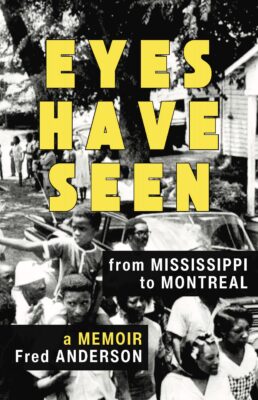
From Mississippi to Montreal
Fred Anderson
$24.95
paper
258pp
9781771863780
Eyes Have Seen can be viewed as a contribution to alternative or counter-history, a crucial perspective that challenges dominant narratives and illuminates forgotten truths. Anderson’s point of view on these events is not only vital; it is dynamic and passionate, remaining true to the curious young self he evokes in earlier memories. This ever-present curiosity also emanates from his detailed portrayals of the real-life characters and places across North America that shaped him.
That said, Eyes Have Seen represents much more than a historical offering – it is also a lesson on the importance of education for enacting real change in the world. It is a testament to alternative education within Black communities and to the resistance and grassroot activism Black individuals have historically needed to advocate for their basic human rights. This sharing of knowledge, strategies, and plans was an essential part of Anderson’s upbringing and belongs to a broader tradition of the Southern African American communities. References to music and songwriters, as well as to books and authors, are sprinkled throughout Anderson’s journey up north, mirroring the crucial role that both art forms played in the Student Nonviolent Coordinating Committee, the civil rights activist group that the author was deeply involved in for most of his young adult years. Thus, Eyes Have Seen emphasizes the importance of community – particularly friendship – for survival and resistance.
Eyes Have Seen’s predominant intertextuality signals another mode of survival, one that avid readers will certainly relate to: making sense of difficult feelings and experiences we aren’t quite sure how to process with beautifully crafted words, whether they be on a printed page or sung alongside melodies on a record. For Anderson, finding solace in books from authors like Toni Morrison, James Baldwin, and H. Nigel Thomas, to name only a few, this experience was exile; his longing for home was barely tolerable, only slightly appeased by the southern recipes he and his friends would cook up in their Little Burgundy kitchen. These intimate moments described by Anderson in Eyes Have Seen show us we can always find hope, even when the political landscape is most hostile to us. mRb


Thanks so much Lea for such a deep appreciation of my journey.
Thanks MBR for featuring a review of my memoir “Eyes Have Seen” in your Summer Issues (2025).
Congratulations Fred!! Very happy for you! Quite an a accomplishment
Thanks Shelly
What a beautifully and concisely written expose of my brother Fred’s memoir of Eyes Have Seen From Mississippi to Canada.