


“A lemon scent hangs in the air,” notices Theodore, a factory worker in Montmagny, Quebec, as he unfurls sticky fly traps around his workstation, “the scent of Marguerite’s hands.” Much lingers in the atmosphere of Mirelle Gagné’s Horsefly. The smell of a colleague’s hand lotion, music, unsettling news, pollution, clouds of dust, “fecal” and “pestilential” odours, “moments of air conditioning,” relentless waves of heat, and, as the title suggests, bugs – “butterflies, dragonflies, beetles, mosquitos, flies, bees, wasps, midges, and stink bugs.”
Translated into English by Pablo Strauss, the thrilling novel alternates between the present day – which finds Theodore suffering through a hot spell and an inexplicable uptick in local crime – and the Second World War, told through two years in the life of an entomologist, Thomas, working at a government-run laboratory. As the two narrative threads move closer together, the characters become increasingly enshrouded in fatal systems of power – both natural and political.
Horsefly Coach House Books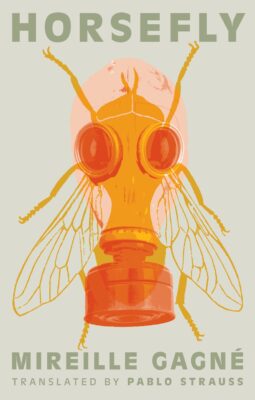
Mireille Gagné
Translated by Pablo Strauss
$24.95
160pp
9781552454992
Reluctantly following these orders, Thomas begins cataloguing the bugs and wildlife in the marshlands on the northern shore. He quickly befriends a teenaged local, Émeril, who has been tasked with helping the researchers move resources between the mainland and island by canoe. Émeril warns Thomas to stay away from certain areas, including the cemetery, and to never let the ubiquitous horseflies bite him. But the Montrealer, who learned everything he knows about entomology “from reading” and has spent little time in the field, is cavalier about this advice. Instead, “day after day, night after night,” he catches, digs, and attracts the island’s many pests until he is “covered in bites.”
Horsefly is a book about consequences. In imagining some of the worst outcomes from real experiments of biological warfare conducted on Grosse-Île during the 1940s – the unearthing of long-buried anthrax spores and the emergence of flies designed to transmit them to humans, for instance – Gagné considers the tiniest players in large-scale global violence and examines how naïve humans are to the long-term impact of our actions. Grounded in her evocative descriptions of the riverbanks and tidal flats across the seasons, the events on the island over almost two years prove far more compelling than the sections that follow Theodore through his mind-numbing workdays and into a precarious public health crisis.
Even so, the two timelines are indispensable to one another and, together, render a nuanced story about the long arc of causality. We watch Thomas react to young Émeril’s sudden illness after transporting flies injected with “a selection of viruses and bacteria, influenza and plague” – moments before learning that, in the present day, Émeril is Theodore’s dementia-ridden grandfather, his only living relative, and possibly the only person who can help forestall the rage spreading throughout the region.
Woven throughout the book are a series of brief chapters narrated by a voracious and unforgiving horsefly that hovers around Theodore for days before wounding him. “Desire rose up from my depths,” it says, recalling the ecstasy of biting Theodore while he was having sex. “I cracked, succumbed, gave in, let drop my final shred of self-control.”
Like the inexorable heat and the unforgiving landscape, these disturbing and intimate vignettes allow a non-human voice to comment on just how merciless and inhospitable we’ve made the world. “We have seen you animated by a rabid fury,” the fly says, “turning on each other, against your own kind.” Poised somewhere between speculative and historical fiction, Horsefly elegantly reveals how limited our view of the future is if we can’t investigate – and excavate – the worst chapters of the past. mRb
0 Comments