

“I want so badly,” Adam Hauin writes in his debut I Am Looking for You in the No-Place Grid, “to write the new natural law.” That desire to remake nature’s law is technological; to reimagine nature through code, to find orientation within disorientation. This book, for its interest in glitch, intimacy, beauty, anachronism, and the voice coming from inside of the computer, is striking, difficult, and altogether magnetic.
I Am Looking for You in the No-Place Grid Coach House Books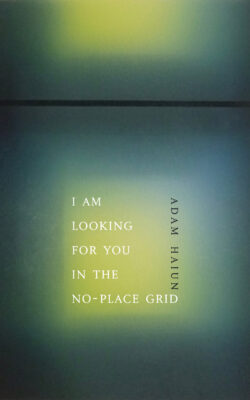
Adam Haiun
$24.95
paperback
80pp
9781552454961
In these breathless, experimental poems, Haiun plays with textual orientation; compact vertical columns are interrupted by fragments that look like lines of code, text boxes disrupt narrative flow, and greyed-out text written beneath the main lines hampers legibility. Voices overlap and collide; the form encourages your eyes to slide across the place, catching snatches of meaning here and there. The effect of this bracketing is not a random disruption but deliberate disintegration, the corruption of data. Yet what is corrupted is never empty: the glitch in the matrix, Haiun suggests, is no flaw in the design, but the design itself
Meaning resists precision. Reading Haiun, one no longer sees the forest, nor even the tree, but the scurrying of ants up the bark – or something even smaller, more minute, in the spaces where legibility frays. Blink, and “a new kind of wave” might knock you out of your seat. This, perhaps, is the new natural law: that meaning in the age of the Cloud arises precisely at the threshold of disorientation.mRb


0 Comments