

My grandfather, ninety-three and an Ottawa native, has fond memories of his earliest trips to Montreal. Visiting the city as a teenager shortly after the end of World War II, he remembers its refusal to go to sleep, and being “elbow to elbow,” packed like sardines on a crowded Sainte-Catherine st. at some unseemly hour. He has developed dementia over the past several years, but every time we talk, he returns to this vivid image of the city that I now call home – long before I ever knew it.
Matthieu Caron’s new book, Montreal After Dark: Nighttime Regulation and the Pursuit of a Global City illustrates how one politician transformed the city’s nightlife in the forty or so years following my grandfather’s initial visit. The divisive figure of Jean Drapeau stands at the centre of this book, which details the former mayor’s over-thirty-year political career and his effort to tame the city’s underbelly.
Montreal After Dark McGill-Queen’s University Press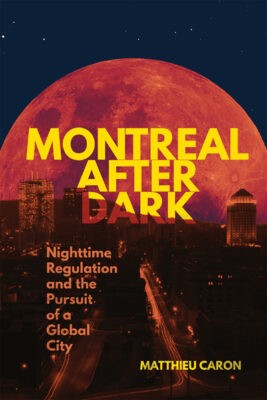
Nighttime Regulation and the Pursuit of a Global City
Matthieu Caron
$34.95
paper
342pp
Following a three-year reprieve from public office in the late 1950s, Drapeau returned as mayor in 1960 with high hopes of making Montreal a “global city.” The two crown achievements of his effort – Expo 67 and the 1976 Summer Olympic Games – reveal the groups that he was willing and ready to sacrifice to put Montreal on the world’s stage. Caron’s investigative dive into the Expo 67 leadup shows Drapeau’s continued effort to eradicate sex work from the visible cityscape, while his draconian tendencies reached full force during the 1976 Olympiad – a spectacle that left the city with a thirty-year debt after costs ballooned to over 1,000% of original estimates.
Caron’s informative but occasionally didactic storytelling reveals other tensions at play in Drapeau’s Montreal. The urban historian’s colourful anecdotes accompany black-and-white archival shots of the city through the twentieth century. The most exciting of these involve the wildcat strikes of the late sixties and early seventies, perhaps most consequentially the sixteen-hour “Night of Terror” police strike on October 7, 1969, and the “Red Weekend” firefighters’ strike, five years later in October 1974. While both examples show the necessity of these two public services to Drapeau’s globalizing Montreal, they also show the power of organized labour in this period. Unfortunately, later anecdotes of Montreal police clamping down on similar labour actions reveal a lack of solidarity with workers among those tasked to protect and serve.
Caron reveals Drapeau’s insistent chipping away at Montreal’s countercultural life through nighttime regulation. Raids on gay and queer community hubs served as a useful tool for Drapeau to push some of the city’s most marginalized citizens further into the periphery, while his crackdown on sex workers marked a national turning point, culminating in the passage of Bill C-49 by Brian Mulroney in 1984.
More than anything, Montreal After Dark offers a portrait of a shifting Montreal, reminding readers of the power our municipal leaders have in shaping the city around us – by day and by night. It comes as a timely history lesson, a call for civic action as Montrealers look ahead to a consequential election this November. mRb
0 Comments