


The aftermath of war is unending. Long after the physical destruction is cleared – swept away and built upon – we continue to suffer its psychological and cultural ravages and wade through the stories of its survivors.
In One in Six Million: The Baby by the Roadside and the Man Who Retraced a Holocaust Survivor’s Lost Identity, Montreal writer Amy Fish weaves together three tales, each ignited by the same war. There’s the story of Stanley Diamond, a businessman who, in life’s second act, became a genealogist. There’s Maria, an elderly Ukrainian-raised, Siberian-based woman, seeking the family who abandoned her as a baby in war-torn Poland. Finally, we have Fish’s own narrative as she reflects on her Jewish roots.
One in Six Million Goose Lane Editions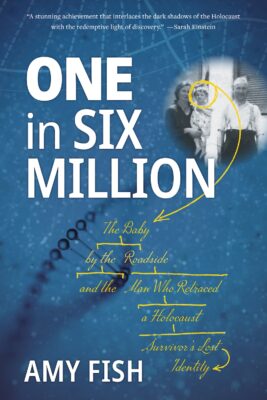
The Baby by the Roadside and the Man Who Retraced a Holocaust Survivor’s Lost Identity
Amy Fish
$26.00
paper
216pp
9781773104249
Maria enters the story decades later, when a visit to Yad Vashem, Jerusalem’s Holocaust museum, stirs something within her: a longing to confirm her Jewish identity and to find the family who abandoned her by the side of a road in Krosno, Poland. Fish’s connection with Maria lacks the intimacy she shared with Stanley, hindered by both distance and language barriers.When the author writes about Stanley, their relationship shines through. She’s conversational in tone, and shares biographical details that one could only garner from an old family friend. Meanwhile, Maria’s section is more historical – we learn about the situation in Krosno during WWII, the world Maria grew up in, raised by the Polish and Ukrainian couple who found her . After Maria moves to Siberia as a teen, Fish describes the rest of her life as “ dull as the blocks of Soviet buildings in her neighbourhood.” Arguably, so was Stanley’s life — these are two ordinary people tied by a remarkable event.
Fish leads up to this event as if she were suddenly writing a detective novel. There are cliffhangers and plot twists that would be more thrilling if I hadn’t already guessed where the story was heading. Fish does her best to inject excitement into what boils down to a series of email exchanges, video calls, and DNA samples sent by mail. In the end, it’s her own connection to the story and the personal tangents she goes on that are the most engaging. Possibly inspired by Stanley, she documents the family history of many people who helped solve the mystery of Maria, connecting their biographies both to her own life and a wider network of people scattered across the world.
While the stories of JRI-Poland, Stanley Diamond, and Maria Vasitinskaya are interesting, I found myself wondering, by the end of the book, whether it might have been stronger as a feature article, and whether such extensive detail was necessary. Do we need to know about Stanley’s illegitimate child or business deals in the Middle East to understand the importance of what he created with JRI-Poland? The multiple memoirs bring a sense of humanity to the more tedious descriptions of genealogical research, but they could have been pared down without losing their impact. mRb
0 Comments