


When Mikhail, a Montreal-based documentary filmmaker, offends the Jewish community with his latest film, the backlash, both at home and through the Anti-Defamation League, sends him packing. “We were living in the age of tell-all, or so I thought. Tell-all is fine, but it depends on who you are.”
Private Number Véhicule Press 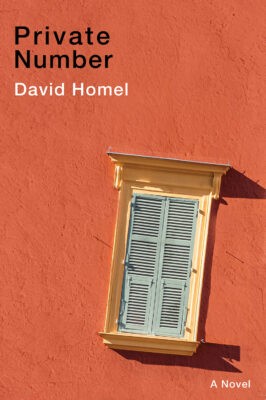
David Homel
$22.95
paperback
240pp
9781550656916
Mikhail arrives at a town in a coal-mining region of France where Didier, his host and the owner of the town’s bookstore, duly introduces him to the other characters: Lili, the elderly matriarch at the nearest vineyard; Marie-Claire, an organizer of the residency; and Caroline, a woman whose face is “burnished like metal” or flushed with the effects of Lili’s wine, and with whom Mikhail quickly embarks on an affair. Caroline is an investigative judge, a profession which elevates her to a lofty status in Mikhail’s eyes, yet which seems to be at odds with the way she conducts her life. Married to a lawyer described by Didier as “a member of the Mafia” and a “caveman,” Caroline elicits sympathy, if not pity, from Mikhail – strange qualities for fuelling attraction, but effective in advancing the plot when the days of his unstructured residency stretch on and boredom is the only emotional rival. If it weren’t for the coal miners’ strike that breaks out, he would have nothing to do but lunch at La Chambre and rendezvous with Caroline. As it is, he engages in acts of solidarity with the union, as do Didier and Caroline in their own ways, and is able to put his cinematic talents to use.
In describing Mikhail’s predicament, Homel sets up the story for an exploration of making art that offends, and what it means to be an artist who is scorned. Mikhail didn’t intend to troll his family, but when he got the offending sequence on film, he couldn’t cut it either. In hindsight, he doubts his true motives. “I was hardly a cineaste; I was an opportunist.”
It’s a timely and contentious premise, and powerful context for a serious novel. But this is not that novel. More a romp in the French countryside, Private Number is a light read that favours local intrigue over philosophical questions. The reader follows Mikhail around, from his bed to his desk to the coal miners’ pit, but not into the depths of his psyche. What toll does outrage take on Mikhail, or on any artist with an unsparing streak? How does scrutiny affect his creativity? His confidence? The likelihood of his continuing to make a living as an artist? Hard to say, but rather than explore these questions, the book indulges the reader with descriptions of wine and the pleasantries of a mature love affair.
As he prepares to address the local crowd at Didier’s bookstore, Mikhail puzzles over what to say until he remembers something he read. “Audiences want to hear about themselves. Talk to us about us.” A sad truism, if it is true, but perhaps a reflection of society after all. To consider the complexities of the life of another, one must invest a bit of oneself. There are times, and books, in which just plodding along can offer a welcome reprieve. mRb
0 Comments