

The A Word: A Global History of the Abortion Struggle is a graphic novel primer on abortion rights and reproductive activism. It’s chunked into short themed sections, linked by a narrator who breaks the third wall to speak directly to her readers.
The A Word University of Regina Press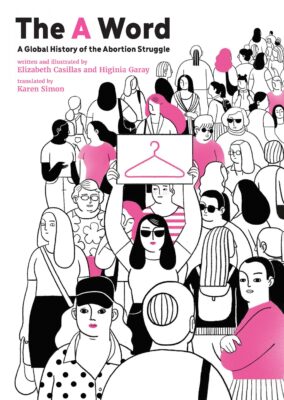
Elizabeth Casillas
Translated by Karen Simon
Illustrated by Higinia Garay
$34.95
paperback
168pp
9781779400963
The A Word opens with, and is driven by, one fact: around the world, women have seventy-three million abortions each year, regardless of local law. Since vast numbers of women choose to end pregnancies for one reason or another regardless, the author reasons, any conversation about abortion regulation is not so much about whether women can access reproductive services as whether or not they are able to do so safely.
The book touches on the horror-show histories of desperate back-alley hanger surgeries, but it also looks at equally appalling practices of involuntary abortions and forced sterilizations imposed on targeted communities. Together, these stories underline another core theme: that the regulation of reproduction is always ultimately an exercise of power over women’s bodies, and using that control to shape population growth.
Casillas connects this thread to the body of first-wave feminist critiques of how medical practices are often “professionalized” in ways that exclude women’s participation in care. Her argument recalls Witches, Midwives and Nurses, Barbara Ehrenreich and Deirdre English’s influential 1970s pamphlet outlining how female practitioners were kicked out of their millennia-old roles in birthing spaces in favor of (mostly male) ob-gyns – and how these shifts often coincide with greater regulation of women’s reproductive choices.
The slim volume covers its topic from as many angles as possible, bouncing from a quickie comic overview of fetal development phases, to a walkthrough of common modern abortive techniques, to a long-view history of abortion law in ancient societies. Most of the book is executed in crisp, high-contrast black-and-white line drawings, brightened by splashes of hot pink. Occasional pastel-wash inserts break up the longer histories with watercolour illustrations of abortifacient herbs and flowers, or snapshot histories of various groups who illegally provided services on ships sailing in international waters, tough-to-trace roaming van caravans, or via anonymously run 1-800 numbers.
Unsurprisingly, The A Word is explicitly, urgently feminist, but class analysis and intersectionality factor in, too. Casillas repeatedly drives home the fact that most of these conversations about abortion access are really only about poor women, since wealthy ones enjoy greater freedom and opportunity. Really, much of the restrictive legislation of reproductive rights is enacted on poor women’s bodies – those who can’t travel across state lines to a public clinic, jet off to a private one, or ask for contraceptives from a doctor they know well.
Overall, Casillas’ authorial voice and Higinia Garay’s approachable illustrations make the topic accessible. The A Word could be used to gently educate a reproductive rights fence-sitter – someone who’s not fully sure where they stand on abortion, but isn’t fully against it – but with its unapologetically “woke” tone, it’s unlikely to convert any MAGA bros or incels (men, as a whole, factor into its story surprisingly little). Instead, the book feels perfectly targeted toward a budding teen feminist who wants to ground convictions in a firm bedrock of facts. mRb
0 Comments