


“I feel a bit greedy,” says Madeleine Thien, then laughs. We’re talking about the complex weave of The Book of Records. “Whatever will help me understand something, I want to bring it in. They’re all ways of seeing, conceptual frameworks, of trying to touch something that’s hard to hold in language. I’ve found that thinking about things through one framework helps me see more clearly through another.”
Thien’s new novel is a story that ranges from deep past to near future, spans continents rich with history and also math, physics, and philosophy, disciplines rarely so well integrated into fiction.
The Book of Records Knopf Canada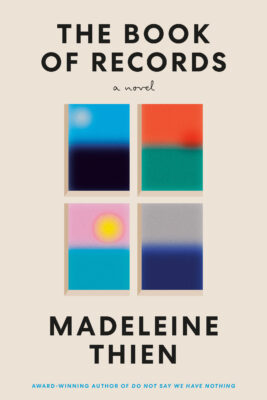
Madeleine Thien
$36.95
hardcover
368pp
9781039009561
The book begins in “the Sea,” where our narrator, Lina, lives with her father. It is a bold way to open, with a setting that has a fluid relationship with time and place.
“I imagined the Sea as a place where time washes in,” Thien explains. “The centuries wash in; narratively it’s about the way different centuries move through us.”
The Sea alternates seamlessly with stories of historical figures who come to life, each in their own vividly imagined times: eighth-century Chinese poet Du Fu, seventeenth-century philosopher Baruch Spinoza, and twentieth-century thinker Hannah Arendt, who famously coined the term “the banality of evil” after reporting on the trial of Adolf Eichmann. What research did Thien undertake to cover so much ground?
“I’d been reading those three for decades. I knew their work, but I was interested in the lives and the world that gave rise to their ideas.”
Did Thien set out to write a novel with philosophers and poets as characters? She laughs again.
“Not at all! I had the building. I had this enclave, the Sea, and the father and daughter. And I had the young girl’s longing for an education. I’m always drawn to what it means to tell the story of another person’s life.”
I comment that often the novel’s characters seem to be speaking to the ethical issues of our current moment.
“It’s probably not a coincidence,” she says. “There is something about the time we live in now that resonates with the times they lived in – it feels so immediate.”
The book engages deeply with ideas of friendship and community. I quote a character who says, “Maybe you and I should set our sights on the world that emerges between each and every person. Maybe imagination is a way to find that place.”
Thien smiles. “It’s a very Hannah Arendt idea, her belief that the world exists between us. It’s not something that I carry, or that you carry; it comes into existence between us. We all lend ourselves to it – no one fully possesses it.”
“In times like these,” says a character sharing a train compartment with Arendt as she flees occupied France, “friendship is one of the only certainties people can give each other. People are obliged to rescue one another.” I ask Thien about this too. She gazes upward while composing her response.
“I feel like the best answer is the answer I keep coming back to,” she says slowly. She says there are two things. One is the poem written for John Berger by Gareth Evans, “Hold Everything Dear,” a plea to cherish the world. Then she paraphrases Israeli scholar David Shulman: “What holds off despair is to act. Even if it is futile, it is not in vain.”
We talk about how the world is changing, described in a near-future China section of the book as the disparity between establishment power and the subversive culture ordinary people are making under the radar. The student Bing, one of the members of the radical group the Floating World, says, “This imbalance is the engine of political change.”
How does she see this happening?
“I think about the desecration of language.” Thien turns her paper coffee cup in her fingers. “There are forces that want to separate the meaning of a word from the word. Even such a fundamental phrase as ‘human being.’ There is a growing awareness of this – a fight to preserve meaning. I see more artists and writers engaged with that. And doctors, humanitarian aid workers.”
What else is she working on?
“Starting another novel, that will be quite different again. And two lectures that I have to give this fall. One lecture about the imagination, and the other about the silence of the bookshelf.”
In November, Thien’s short story “The Artisans” will appear as part of Objects Talk Back, a series focusing on art – mostly looted – in the collection of Berlin’s Humboldt Forum. (As will an essay by Rawi Hage entitled “The Call,” about a fragment of text from the same source). “The Artisans” is inspired by a piece of a Uighur cave mural taken by German archeologists in the early 1900s from the Northern Silk Road, now called the Xinjiang Autonomous Region, where Uighurs suffer relentless persecution. Most of the panels were destroyed by Allied bombing in WWII; this one, improbably, survived.
“It’s very moving, all of it,” she says, about the layers of history. “Some of the stories around these objects… there’s so much to face up to.”
Having left a tenure-track position at Brooklyn College, Thien continues to teach remotely from Montreal. Why the change? “Hard to be divided between two places. I worked there on a visa and over the seven years it was clear the situation was changing. It wasn’t comfortable.” She pauses. “And it was age. It was time to come home.”
Of course, she is still doing publicity for The Book of Records. “The hardest part over this year is talking about a book when so much else is happening. I feel we need to be talking about Gaza, and about these detentions in the United States, and about the ways that we talk to each other.”
I remind Thien that when she was writing Do Not Say We Have Nothing (2016), she told me she was “working on a book about a group of music students in Beijing” – a wildly modest description of her powerful account of events around the massacre at Tiananmen Square. How about The Book of Records?
“What is it about?” Thien thinks again, but not for long. “I think it’s about ethics.”
Was she aiming to comment on contemporary politics?
“Maybe what I want is not that specific. I hope that a reader will just live with these human beings. That quality of recognition is not something that can be forced; it’s something that arises, if we are fortunate. I imagine that as a novelist I’ll keep looking for ways to open ourselves up to that possibility. It’s something that happens on so many levels of a person that you can’t plan it. And maybe it’s most powerful when it takes us by surprise. In that moment we’re also recognizing something in ourselves.” mRb
0 Comments