


Do Canadians only smoke weed without tobacco? Does Stompin’ Tom Connors still speak to local songwriters today? These and other questions are touched upon in Philippe Mineau’s The Guilt Trippers, about a musician and stay-at-home dad chafing against the constraints of domestic life after moving to Montreal’s Little Italy.
The Guilt Trippers Baraka Books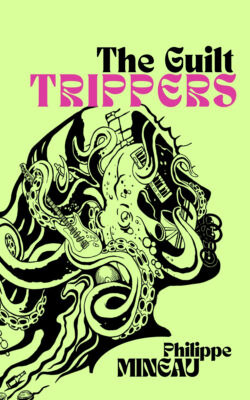
Philippe Mineau
$24.95
paperback
200pp
9781771864107
The Guilt Trippers is at its best in its vivid descriptions of the city’s neighbourhoods, as well as the anxieties and uncertainties of the Montreal musician lifestyle. The grit, camaraderie, and seedy lack of glamour all ring true, as does the frustrating nature of being in a band with self-centred trainwreck types. Drummer Wilburn’s reasons for continuing to grind it out against all odds feel heartfelt: “It’s an escape… A little recognition for all I am, for all I can do. Otherwise, I’m just some bum on the street.”
Nonetheless, it’s more of a slice-of-life-cum-domestic drama than an actual dive into Montreal’s music scene. The references to Neil Young, Mick Jagger, and Canadiana tropes like canoes and wandering Newfies don’t feel truly representative of the city’s weirdo, avant-garde nature. Later mentions of King Crimson, the Pixies, and Modest Mouse are closer to the mark.
Mostly what we’re presented with in The Guilt Trippers is a bunch of aging hosers who enjoy hanging out and smoking weed. Despite the band being together for five years, songwriter and supposedly brilliant talent Dean can barely remember the lyrics to their five songs, and they’ve yet to record a demo. Maybe that’s the point – that the members of the band are presented as cautionary tales, crusty veteran musicians looking down the barrel at a life of failed dreams, lack of marketable skills, niggling addictions, and chronic poverty.
What it’s really about is the challenges of coupledom and raising children in the often cramped quarters of this city. As such, it’s a bit of a bipolar beast, veering between dank jam space and cozy homefront, edgy fantasy and wholesome reality. And yet, in a Mile End Kicks kind of way, it feels like a cute romanticization of the lifestyle and an ode to escape-hatch musical dilettantism. The debauchery that Moe feels guilty about is mostly limited to weed, smokes, some mushrooms, and a few dabs of MDMA – nothing very heavy or menacing.
The ending suffers from an excess of clunky metaphoritis, replete with cracks in the jam space’s foundation and literal walls falling down. But not to worry, dear reader, redemption is at hand, and we learn that the burnt-out Dean has a good heart and a heroic nature. He somehow even manages, post-disaster, to seduce a young nursing student from his hospital bed, addressing her as “Deary” while sarcophagused in multiple casts. Quite a feat, and one that stretches credulity – much like the fantasy jam space quickie with a young rock chick (“…as she comes…” is wishful thinking), whose moral repercussions Moe never seems to grapple very hard with.
Mineau does granular description and existential questioning better than he does fictional scene-setting. The most touching moments are when the musicians open up to each other about their vulnerabilities. I could have used more such emotional gravity. On the flip side, I did wonder why, at one point, I was reading twenty pages of graphic detail about a toddler’s penis infection.
Mineau writes with an admirable flow – always harder than it seems – and should be commended for taking a crack at fertile material that merits further exploration. Much of the book is engaging. But in a city that’s spawned the likes of Godspeed, Duchess Says, and Backxwash, the portrait feels a little bro-y and conventional, strangely denuded of the qualities that make Montreal stand out – more CHOM 97.7 than CISM or CKUT. mRb

0 Comments