


A glance at the cover of The Hidden Curriculum of Video Games, a solid black background with a child under an ominous digital filter in the corner, and one might be tempted to add David I. Waddington’s book alongside other works decrying video games as an aggression-engendering machine designed to prey upon young, impressionable gamers. And although Waddington dedicates his first chapter to a cursory examination of the argument that video games cause violence (and debunks any inflammatory theses on the topic), he directs his focus to a more pressing question: If video games don’t cause violence, in what ways do they affect us?
Drawing from American psychologist John Dewey, Waddington frames his critique of games through an educator’s lens, interrogating specific games throughout for their potential to teach. To this point, Waddington explores the capacity for knowledge-based learning in the context of his own students playing Fate of the World – a game exploring national policies and their effect on climate change – in Chapter 6. But before The Hidden Curriculum of Video Games dives into games’ potential to educate, Waddington focuses on troubling trends observable in mainstream games.
Chapter 4 breaks down an insidious but persistent set of political leanings in the design of mainstream games or AAA games—games produced by major publishers with large budgets. Inherent in these games, Waddington argues, is an exaggerated “techno-optimism,” as well as “the omnipresence of rhetorical and structural elements of freedom” and “a generalized hostility to the state” – key components in his breakdown of a political ideology he introduces as “technolibertarianism.” And the “techno” of technolibertarianism isn’t limited to games that feature the speculative technology of the future; Waddington compares the technology in Cyberpunk 2077 with fantastical elements in Baldur’s Gate 3 and pronounces them as functionally identical, the difference between a sci-fi and fantasy game “a stylistic one.” Reinforced across genres in mainstream games, Waddington points out, is also a “cruel meritocracy”: “The view here is that great players put in their time, and they reap the rewards they deserve. The corollary, of course, is that losers deserve the derision they get.”
The Hidden Curriculum of Video Games McGill-Queen's University Press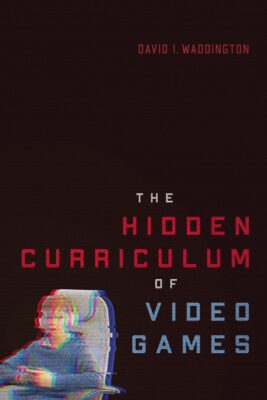
David I. Waddington
$34.95
paperback
304pp
9780228027881
But in underlining the hazards of video games, Waddington also takes care to explore how games can “offer up the possibility of growth, not just in terms of growth of propositional knowledge and competence, but growth in terms of the horizon of possibility through the aesthetic experiences they make possible.” Waddington focuses on two personal examples of wildly different aesthetics, that of the game Hypnospace Outlaw and The Longing, examining the ways in which they succeed as works of art based on English film theorist Peter Wollen’s seven strategies of counter-cinema outlined in Chapter 7. His optimism is nevertheless cautious, a sober argument that “what is to be gained, educationally, from aesthetic experiences in games is going to be difficult to pin down and highly variable.”
Whether or not the nebulous benefits of games are worth navigating the landscape littered by technolibertarianist narratives is hard to say, but it may be necessary regardless, as “refusing to play the ‘game’ of hypermodernity is harder than it might seem.” Video games aren’t going anywhere, and The Hidden Curriculum of Video Games equips educators, artists, and players alike with a foundation with which to grapple with the ways that games change us and those around us.mRb


0 Comments