


Grief, like love, is a story that’s both personal and universal. It is both a process and state, silent yet deafening. A baffling, life-changing thing that can withstand contradiction: everyone throughout time has felt this loss, and; no one has ever felt this loss.
The Mongoose Pow Pow Press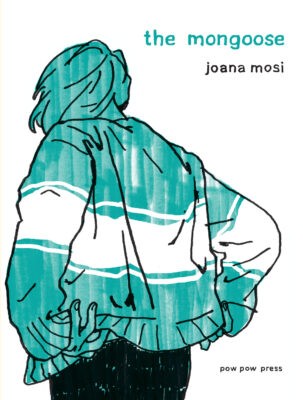
Joana Mosi
$29.95
paperback
170pp
9782925114475
That disbelief echoes out into all of her relationships, compounding the usual frictions where characters struggle to connect. Júlia admits to her therapist that she and Joel don’t talk much, and even conversations with her mother or her aunt feel forced. We follow frustrating lunches between Júlia and her mother as they butt heads about salad bowls and tofu preparation: well-intentioned emotional check-ins, sidetracked by bickering. How much harder is it to reach someone when neither of you knows how; how adrift do we feel when we don’t have the right words?
In fact, in many panels, Mosi lets the silences, interruptions, and blank stares do the talking. Characters in conversation rarely face each other, and a good amount of portraits are drawn completely faceless, mouthless, or with their backs turned three-quarters to the “camera.” The rarity of facial expression reminds me of work by Nick Drnaso, who has a similar knack for evoking tension and complex, conflicting emotions with vacant looks and wide eyes. At times I wished we got a bit more emoting from these characters, but the frequent lack of facial features makes the appearance of pursed lips or even two angry eyebrows stand out all the more.
Fans of Lee Lai or R. Kikuo Johnson will enjoy Mosi’s even linework and soft, rounded shapes. She demonstrates a keen understanding of pacing in her form, and imbues even quiet moments with tempo and depth. Worms wriggle in the dirt as Júlia paces back and forth; families debate why a husband left while two kids fight over a stuffed toy. Júlia slouches on her bed until it crumples inwards like tissue paper, an imploding star. And as she goes for a run or cooks dinner, the portrait of the mongoose flashes in.
Júlia’s conviction that a mongoose is destroying her garden, not some other animal, quickly warps into obsession. Barely a conversation goes by without her mentioning it, haunting her late nights and internet searches until she unexpectedly breaks. “He’s everywhere,” Júlia finally tells her mother, “I see him everywhere, all the time.”
And here Mosi reveals her lens on grief, the mix of denial and avoidance that feel like a comfortable cage. The animal gaze of Júlia’s loss – a wild thing running loose in the garden – is too painful to hold. It is easier to approach at a slant, to walk towards it backwards rather than head-on. But it’s only when Júlia manages to speak about it directly that the view clears, and reflections of her real memories finally start to seep in.
The Mongoose recognizes grief as an exhausting, isolating, unfinishable story; something that sneaks up on us, scraping the sides of our consciousness without warning. Under Joana Mosi’s pen, it is keenly and kindly told; a story that, throughout time, will always bear telling.mRb

0 Comments