


It’s best practice when reviewing a book, at least in my reckoning, to lead with the positive and interesting aspects. As any writer will tell you, it’s no small feat to compose 230 pages; the effort alone is something to be proud of. So, the first nice thing I will say about Jeremy Thomas Gilmer’s book – an autobiographical account of his “twenty-five years working for some of the largest mining and engineering companies in the world” – is that it offers an incredible geographical and topological wingspan. Peru, North Carolina, Angola, Bolivia, the Northwest Territories of Canada, Congo – an impressive list of regions, no doubt.
This Rare Earth Véhicule Press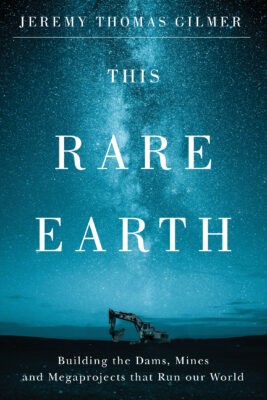
Building the Dams, Mines and Megaprojects that Run our World
Jeremy Thomas Gilmer
$24.95
paperback
230pp
9781550656794
I will also grant that the book does, as Gilmer promises in the introduction, provide us with a perspective “rarely heard from in the debate: an extraction industry with deep connections not only to the environmental challenges we face as a species, but also the very systems that support our everyday lives.” Fair enough. Being an expat brat myself (my father is an engineer whose contract work took us all around Southern Africa), I can vouch for the validity of the claim that this is a low-key, behind-the-scenes perspective, often unheard by laypeople.
Only, Gilmer never clearly lays out the stakes of the “debate” he refers to. Right up until the conclusion – in which he offers an equally pithy and vague call to action – I remained confused about what it is that Gilmer wants us to think, do, or change.
If pressed to distill the story’s moral, I’d say it’s simply this: being a mining engineer is a dangerous gig. A disappointingly flattening throughline. The book opens on the tailings – the heaps of waste rock skirting a mine in Peru – where we first meet Gilmer as he abseils down a sheer slope to assess the stability of a dam. This scene is a fitting microcosm of the book as a whole, which is full of similarly high-stakes moments: men wielding chainsaws in flip-flops, minus-30-degree cold, floods, fires, lethal snakes – hard-boiled men doing hard-boiled work, all narrated in the clipped tones of a safety narc who has, regrettably, watched Apocalypse Now.
There is no denying that Gilmer has lived a particularly interesting life: his work in this unusual field has taken him to all sorts of far-flung, exotic places, some of which I’d never heard of. And if this were all the book claimed to be about, then perhaps I would have enjoyed it more. But if This Rare Earth was meant to add a new perspective on pressing issues like global power structures, neocolonialism, extraction culture, and climate change, I am left seriously wanting.
For all his globe-trotting, Gilmer’s autobiographical mining account never penetrates very deep, skimming along the surface of the world. Ultimately, he fails to locate himself and his work within the mechanics of the larger system. What does it mean that he, a Canadian engineer, personally supports the often harmful (to land as well as people) extraction of international resources? Enough about the time you (almost) had an encounter with a puff adder in the Congo; tell us what it’s like to work in an explicitly fraught industry, your interpersonal interactions and tensions with other engineers or locals, how that makes you feel, why, and what you think should be done about it.
This neglect is linked to Gilmer’s larger faux pas. He fails to build a coherent big-picture story: How do these extraction projects connect or interact? What does it mean that Canadian companies, some of the world’s most aggressive extractors, are mining in the Congo, Angola, Peru? And, by extension, he never asks the key question: Can we do things differently?mRb


0 Comments