


Like most cleaning, waste collection is nearly invisible when the system’s working. At home, we hide our trash in neat cupboards and shiny-lidded bins, then ferry it to the curb once a week to be magicked away. As Simon Paré-Poupart puts it, garbage disposal is “an activity you’d rather not see, carried out by people you’d prefer to ignore, whose purpose is to make the countless things you no longer want to see disappear.”
Trash! A Garbageman’s Story pulls back the curtain on urban waste while taking the reader on a brisk journey behind the garbage trucks of Montreal. A committed freegan, Paré-Poupart challenges our complacency about overconsumption and planned obsolescence as he digs into citydwellers’ conflicted relationship with waste. “The garbageman is the Sisyphus of our consumer society,” he writes, “a hapless labourer condemned to go from house to house picking up bags, swept along day after day in the never-ending flow of refuse we produce. And every day he is fated to resume this labour afresh, again and again, for all eternity.” This critique sits beside some surprisingly joyful paeans to garbage collection and the people who do it, in a slim volume that flew off the shelves in its original French edition.
Trash! Melville House Publishing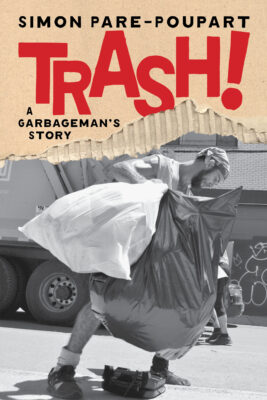
A Garbageman’s Story
Simon Paré-Poupart
Translated by Pablo Strauss
$24.99
paperback
192pp
9781685892494
He may be a proud member of the loose brotherhood of misfit sanitation workers, but he’s also a bemused portraitist of their many eccentricities. Garbage route staffing is loosely contractual and vaguely mercenary, and Trash is populated by a rough-and-tumble cast of men: “guys missing teeth, guys with tattoos, guys whose clothes looked like they came out of the garbage (and often did).” We meet garbage collectors who go to work on mushrooms, one who routinely gets arrested mid-shift, and a guy called Spandex, so named for the shorts he wears on his route, shirtless and in flip-flops.
Riding a truck’s footrail in traffic while chucking fifty-gallon bags of waste into a compactor’s maw is intensely athletic, the work so hard Paré-Poupart casts it as a form of self-violence. For him, the rush of that heroic physicality is part of the draw, and he even argues that the smell grows on you, eventually becoming beguiling. The downside? Oblivious, sometimes hostile citydwellers who make the job harder, which he caricatures in quick encounters brimming with class contempt.
Overall, his storytelling moves quickly and stays light, and Pablo Strauss’s English translation retains a lyrical quality (“my vamping sowed seeds of doubt”). Even when Paré-Poupart pulls in academic insights – Bourdieu, Bataille, Deleuze, and Zola all pop up – the references are glancing and seldom inform a deeper analysis. Trash! can be a bit tough to connect with emotionally and reads more like a rant than an exposé, but it’s an entertaining one. For most of its readers, who likely rely on garbage removal services yet think so little of them (literally and figuratively), it’s Paré-Poupart’s fierce pride in sanitation work and the people who do it that make this book sing, showing us a layer of our own lives that we mostly don’t see or care to know too much about.mRb


0 Comments