

What would your ex say about you if they told the story of your breakup? This question is at the core of Jean-Philippe Baril Guérard’s latest novel in translation, which details the euphoric rise (and dramatic fall) of an ill-fated romance that plays out in the small, often cramped world of francophone comedy in Montreal. You Crushed It begins with a direct address: “You told yourself nothing bad could happen.” Guérard has made the unconventional choice to write in second person, placing the reader in the perspective of his protagonist, Raph, a recent comedy school graduate and stand-up comedian whose main purpose seems to be one-upping his best friend, Sam. “Whenever you’re better than Sam, you feel great,” Guérard notes.
You Crushed It Book*hug Press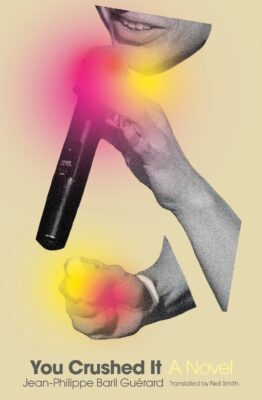
Jean-Philippe Baril Guérard
Translated by Neil Smith
$24.95,
paper
278pp
9781771669313
Much of the narrative is told in future tense, with Laurie describing their relationship in a prophetic tone, as if it has yet to unfold. “We’ll do what normal couples do,” she begins – a fortune teller peering into their shared future. She paints a picture of what’s to come: they go clubbing and do MDMA at Berghain in Berlin, hard-launch their relationship on Instagram, get drunk and high on weed and Ritalin to write comedy in a cottage in Ange-Gardien – “brainstorm, take notes, eat, fuck, joke around, rewrite, drink, chill, get a brilliant idea, write it down, develop it, smoke, fuck” – and the bottomless downward spiral that unfolds when it all starts to fall apart.
This formally complex perspective is a joy to read in the hands of Guérard, who has crafted a psychological page-turner sustained by an addictive rhythm that surges and stalls with the momentum of Raph’s increasingly high-stakes triumphs and embarrassments. This is a testament to the original prose as much as to Neil Smith’s translation. Smith has risen to the challenge of translating a dialogue-driven book in which characters speak to each other almost entirely in sarcastic jabs, slang, and inside jokes, while preserving Guérard’s precise, dry humour. “Everything is fucking amazeballs,” is Raph’s response when asked how he is doing post-breakup (spoiler alert: he’s not doing well). The novel’s francophone origins remain evident in its strong sense of place. On the verge of a nervous breakdown, Raph chases success while fielding interviews on Radio-Canada Gatineau and Énergie FM or competing on local TVA game show Le Tricheur.
Raph’s trajectory unwinds the association between success and happiness as his career balloons steadily alongside his depression, culminating in a scene characteristic of Guérard’s irony: Raph lies catatonic on the floor of a hotel hallway while an employee tells him, “I really like what you do.” Through this unravelling, Guérard explores the ubiquity of alcohol within comedy scenes, the many faces of toxic masculinity, and, when Raph’s cohort becomes the subject of a scandal, the complexity of call-out culture in the era of #MeToo. Beneath the quippy dialogue and clout-chasing is an emotionally charged exploration of insecurity, infatuation, and the consequences of basing success on the failures of others. mRb
0 Comments